AI Product · Research
Àva
A styling app that understands your face, skin shade, undertone and body, and gives you personalized tips.
The problem
A lot of my friends, women and men, now ask ChatGPT to analyse their face. They upload a selfie and ask what colours suit them, what their undertone is, which foundation shade to buy, which haircut would work, what their body shape is. And then they actually go and buy the foundation it picked, book the haircut it suggested, and stop wearing the colours it told them to avoid.
I evaluate AI models for a living, and this caught my attention. There are evals for legal, finance and coding. I couldn't find anyone checking whether a general-purpose model can read skin tone, face shape or body proportions from a phone photo, or whether it reads them equally well for darker and lighter skin.
The human alternative isn't a clean answer either. A colour analysis session in San Francisco costs roughly $150 to $600, and colour seasons are a stylist convention that has barely been tested scientifically, so even experts don't have a proven method.
What Àva is
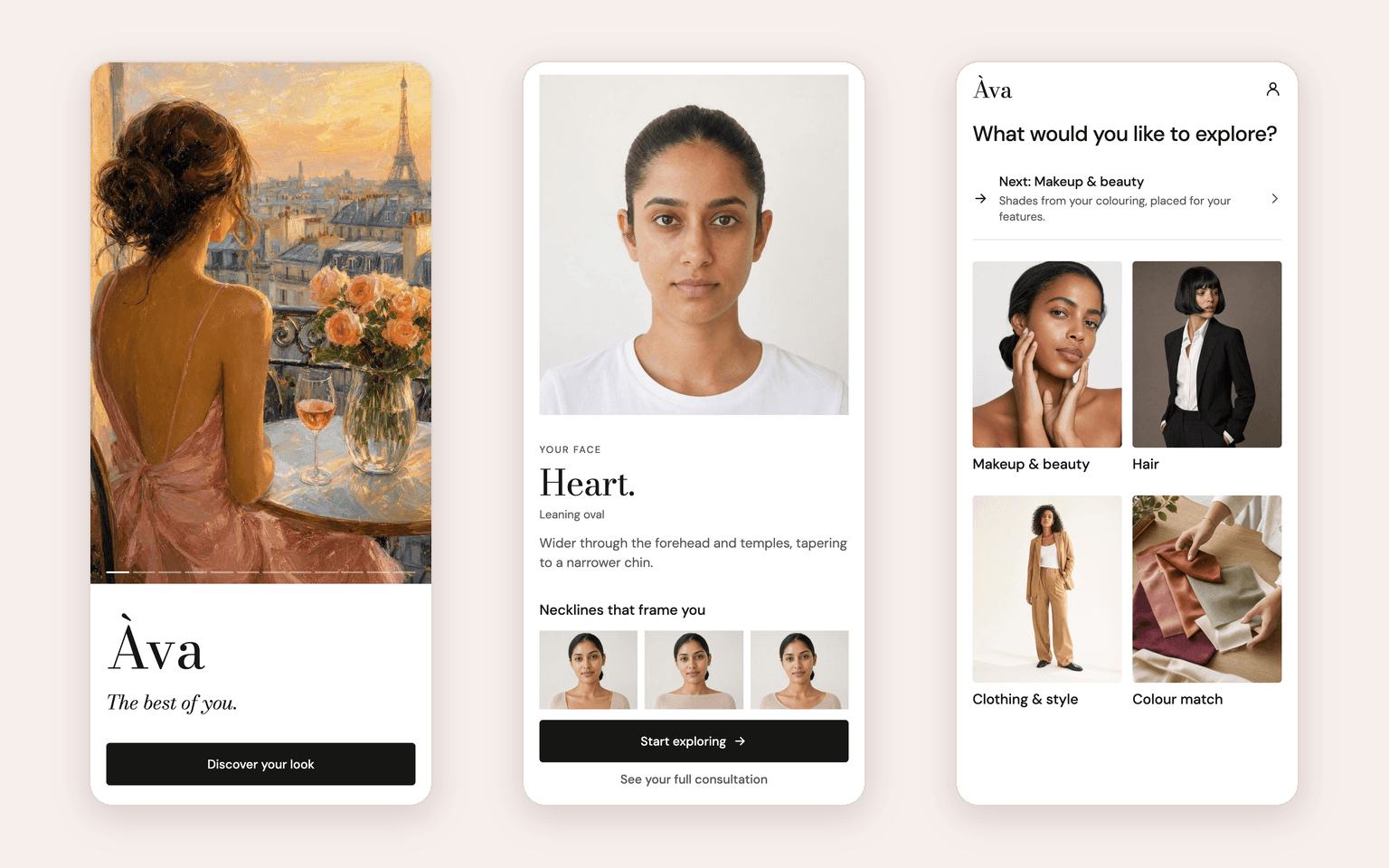
Àva is a personal-styling app that works a bit like having a good stylist take a proper look at you. You take a single selfie, and Àva measures your face and colouring right there on your phone, then recommends the makeup, haircuts, clothing shapes and colours that are most likely to suit you, and lets you try any of them on your own photo before you spend money on them. Right now it runs as a web app on your phone, and the first round of testing is with five or six women.
What I care about most is that every recommendation is backed by science, or at least by a reason that's written down, so that the advice stays consistent. A chatbot can call you a Soft Autumn today and a Warm Spring tomorrow just because you uploaded a slightly different photo. Àva traces each suggestion back to a measurement, a written rule and a source, so the same face gets the same answer, you can see exactly why it was given, and you can overrule it whenever you disagree.
How it works
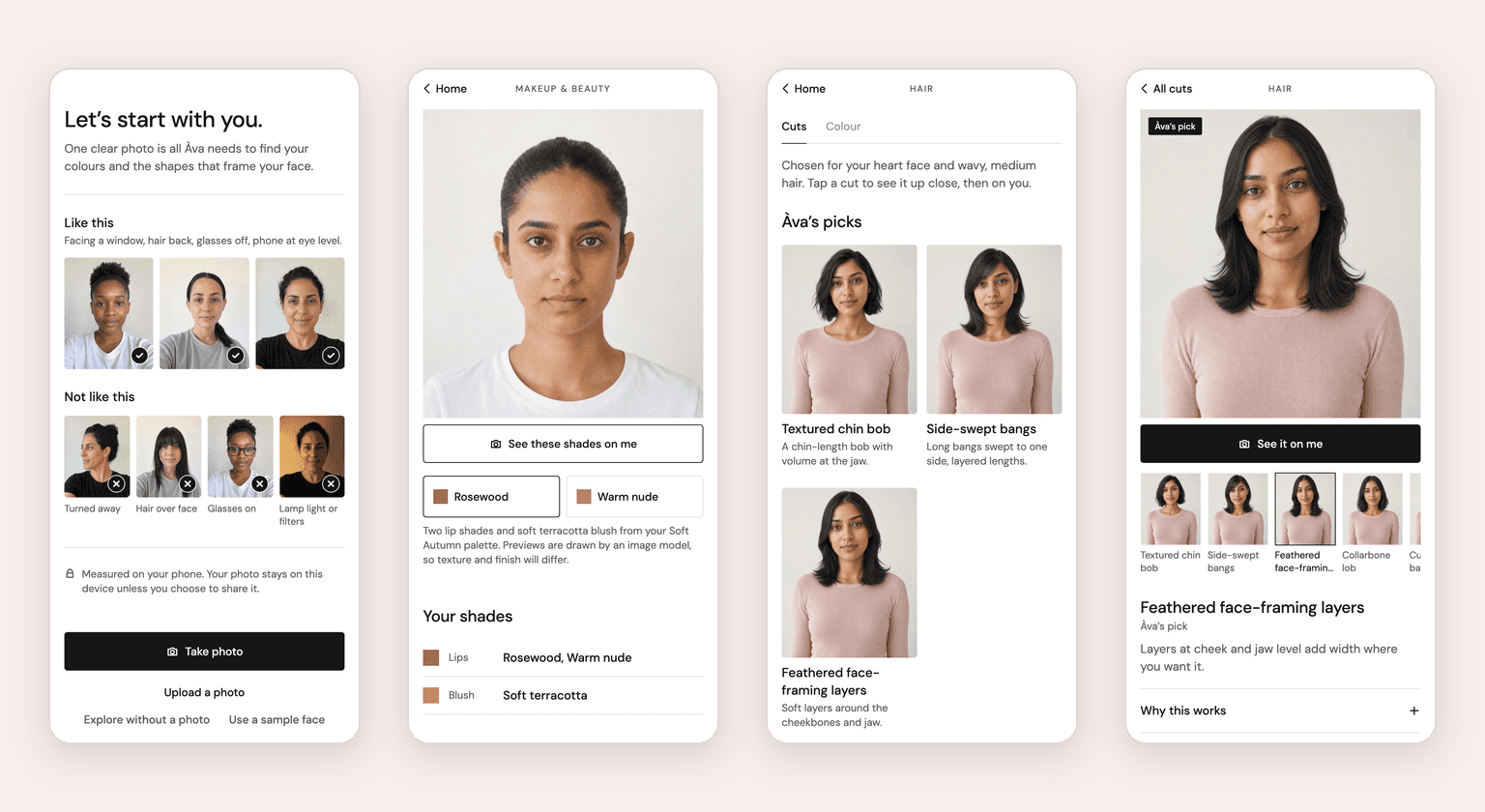
It all starts with one guided selfie, which Àva measures on your phone so it can tell you one useful thing about your face straight away, and it only asks follow-up questions, like which foundation you already wear, when the colour reading looks unreliable. From there you can explore makeup, hair, clothing and colours in whatever order you like, with Àva's picks shown first, and you can correct anything it gets wrong along the way. The map below shows the whole journey.
Get started
About a minute
- Welcome
- One selfie
Or upload a photo, use a sample face, or explore without one
- Colour check
Only when the colour read is unsure
- First reveal
Your face shape and the necklines that frame you
Explore
A suggested order; every area opens from Home
- Makeup & beauty
Shades, placement, your foundation
- Hair
Cuts and colours, tried on you
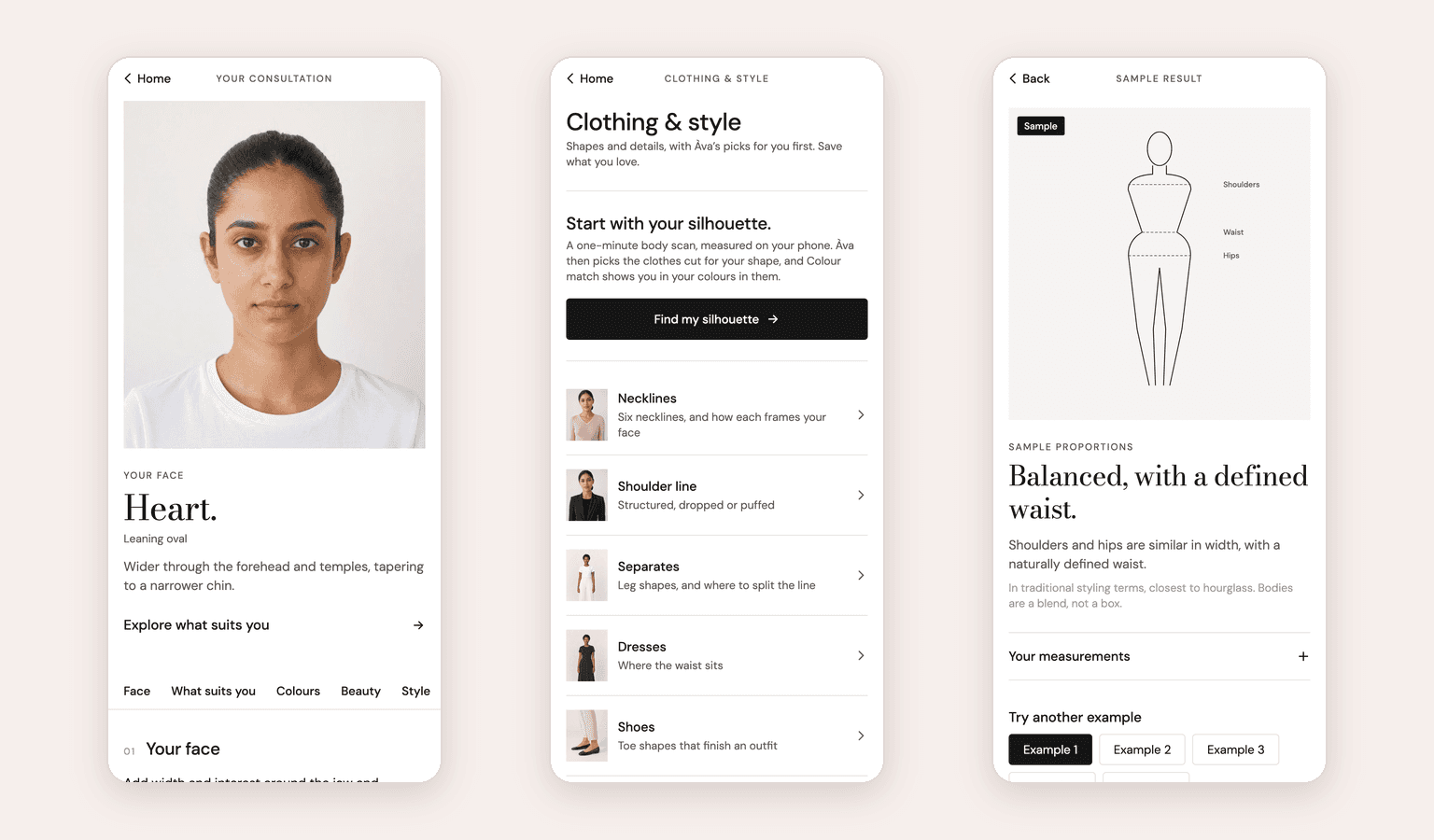
- Clothing & style
A short body scan, then clothes for your shape
- Colour match
You in your colours, in those clothes
- Your look
Outfit, hair, makeup and colours together
Make it yours
Any time, from your profile
- Full consultation
- Saved looks
- Your style
Ten optional this-or-that picks
- Your proportions
How you get your analysis
What you give it
From the live camera, about 30 frames averaged together, or an upload.
Optional. Front and side photos, deleted as soon as they're measured.
The foundation you wear, your hair type, this-or-that picks, and any corrections.
Measure
On your phone
Hundreds of points on the face give its proportions and the shape of the eyes, lips and brows.
Skin, hair and eye colour in a colour space built around human vision, corrected using the whites of the eyes.
Shoulders, waist, hips and leg length from body points and the outline of the figure.
Decide
On your phone
The closest of six shapes, described as a blend when it's close.
A shortlist of seasons. Close calls go to a drape test.
Works back from the shade you already wear.
Cuts from face shape and hair type. Colour planned from your natural level.
Where liner, blush and definition go for your features.
Necklines, shoulders, waistlines and trousers for your proportions.
Each option is ranked Best, Also works or Less natural. Your taste reorders options within a rank, and your corrections override everything.
Show
In the cloud
Hair, necklines, earrings, makeup and colours drawn on your own photo, only when you ask. A server writes the prompt from your choices, so it can't be used for anything else.
A ready-made library where each option is an edit of the same base photo, so only one thing changes.
Decisions modelled on how experts decide
Before writing any rule, I studied how the professional who would normally make that call actually goes about it: what they look at first, what they ask you, and how they settle it when it's a close call. Àva then tries to follow the same reasoning when it makes a decision.
Who
How they decide

Colour analyst
Works in daylight. Judges depth first, then warmth, then clarity, and settles close calls by holding two fabrics against a bare face.
Beauty advisor
Swatches foundation along the jaw and reads your undertone from the shade that disappears into your skin.

Hairstylist
Chooses a cut from face shape together with hair texture, thickness and how much styling you'll do.

Colourist
Starts from your natural level on a 1 to 10 scale, picks a target, works out how much lightening that takes and what warm tones it will reveal, then picks a technique.
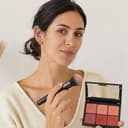
Makeup artist
Places liner, blush and definition to balance eye spacing, eye shape, lip proportions and face shape.

Personal stylist
Picks necklines, waistlines and trouser shapes to balance shoulders, waist and hips, and treats body types as a mix.
Where it falls short
Can a phone photo really do this? Only partly, and only in conditions that most quick selfies don't meet.
Part of this experiment is also to find out whether there's any truth to colour and style advice in the first place. Is there real science behind what looks good on someone and what doesn't, or is it mostly subjective, a matter of taste and trends? And if it does turn out to be largely subjective, the next question is how good vision models can be at that kind of judgement at all, when there isn't a single right answer to check them against.
The camera and the light
- A photo records your skin mixed with the light falling on it, and the phone then adjusts the colours to look nice, sometimes "correcting" your skin as if it were the lighting.
- The same face can read as a Deep Autumn by a window and a Deep Winter under a warm lamp.
- Àva averages about 30 frames and uses the whites of your eyes as a white reference, but that's still a long way from the calibrated device Sephora uses in its stores.
The AI models
- In a study of simple visual tasks people do at a glance, humans scored 96% and GPT-4V scored 51%.
- A 2025 study of 32 vision models found that colour understanding has been "largely neglected."
- GPT Image 2 washed out warm brown hair colours in my try-ons, so I redrew those with Nano Banana Pro.
One photo of a three-dimensional face
- Àva only sees your face from the front, and a selfie taken at arm's length makes the middle of the face look bigger than it is.
Not yet tested on real faces
- The numbers were tuned on seven AI-generated portraits and five generated bodies, so how accurate Àva is on real people, and on deeper skin tones in particular, is still unknown.
What's next: building the first eval set
Building Àva convinced me that the more important work is testing the AI tools people already rely on for this, especially since face recognition has already shown how unevenly these systems can fail: a 2018 study found commercial systems got the gender of darker-skinned women wrong up to 34.7% of the time, compared with at most 0.8% for lighter-skinned men.
If you've ever had an official colour analysis, please share your results with me and be part of the first evaluation set. I'm also looking for collaborators, whether you're a colour analyst, hairstylist, makeup artist or designer, or you work on generative media or vision models.
Sources
- Kartynnik et al. (2019), Real-time Facial Surface Geometry from Monocular Video on Mobile GPUs
- Magtiza (2021), Hair Colour for Hairstylists: Level 2, BCcampus
- Smartphone tristimulus colorimetry for skin-tone analysis, Biophotonics Discovery
- Correlated illuminant estimations, US patent 11153547 (skin and automatic white balance)
- Fu et al. (2024), BLINK: Multimodal Large Language Models Can See but Not Perceive
- Liang et al. (2025), ColorBench: Can VLMs See and Understand the Colorful World?
- The Pudding, foundation shade data (MIT licence)
- Buolamwini and Gebru (2018), Gender Shades, PMLR 81
- The San Francisco Standard (2024), on colour analysis parties and their prices