AI Product
Bookmarked
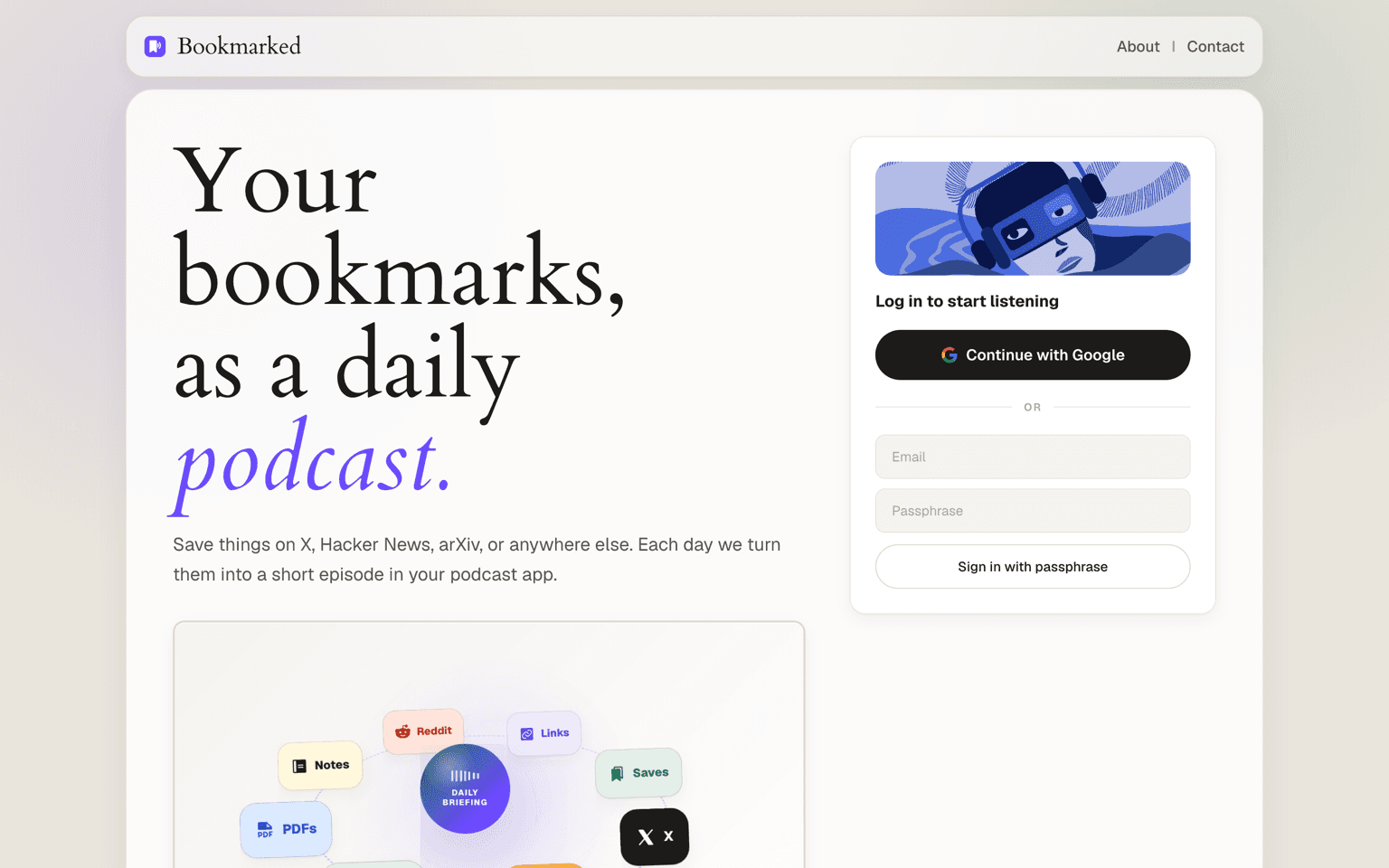
A podcast made from the things you save online, so you actually get through them.
Why I built it
I save a lot of things during the day: posts on X, articles, research papers. I almost never go back to them. Saving takes a second; reading it all later never happens.
At the same time, I spend about two hours a day on the Caltrain commuting to work. That's a lot of time, but reading on the train strains my eyes, and I'd much rather listen. So I built something that reads my saves back to me as a short podcast episode.
How it works
You tell it where you save things and how you'd like it to sound. After that there's nothing to do but listen.
- Connect your saves. Bookmarks on X, favorites on HackerNews, saved posts on LinkedIn, or your Chrome reading list. If you don't save much, you can follow a topic instead, and it finds new research papers for you.
- Pick a style. A punchy news anchor, two hosts chatting, a calm morning briefing, or a casual tech chat. You also choose the length and what time it arrives.
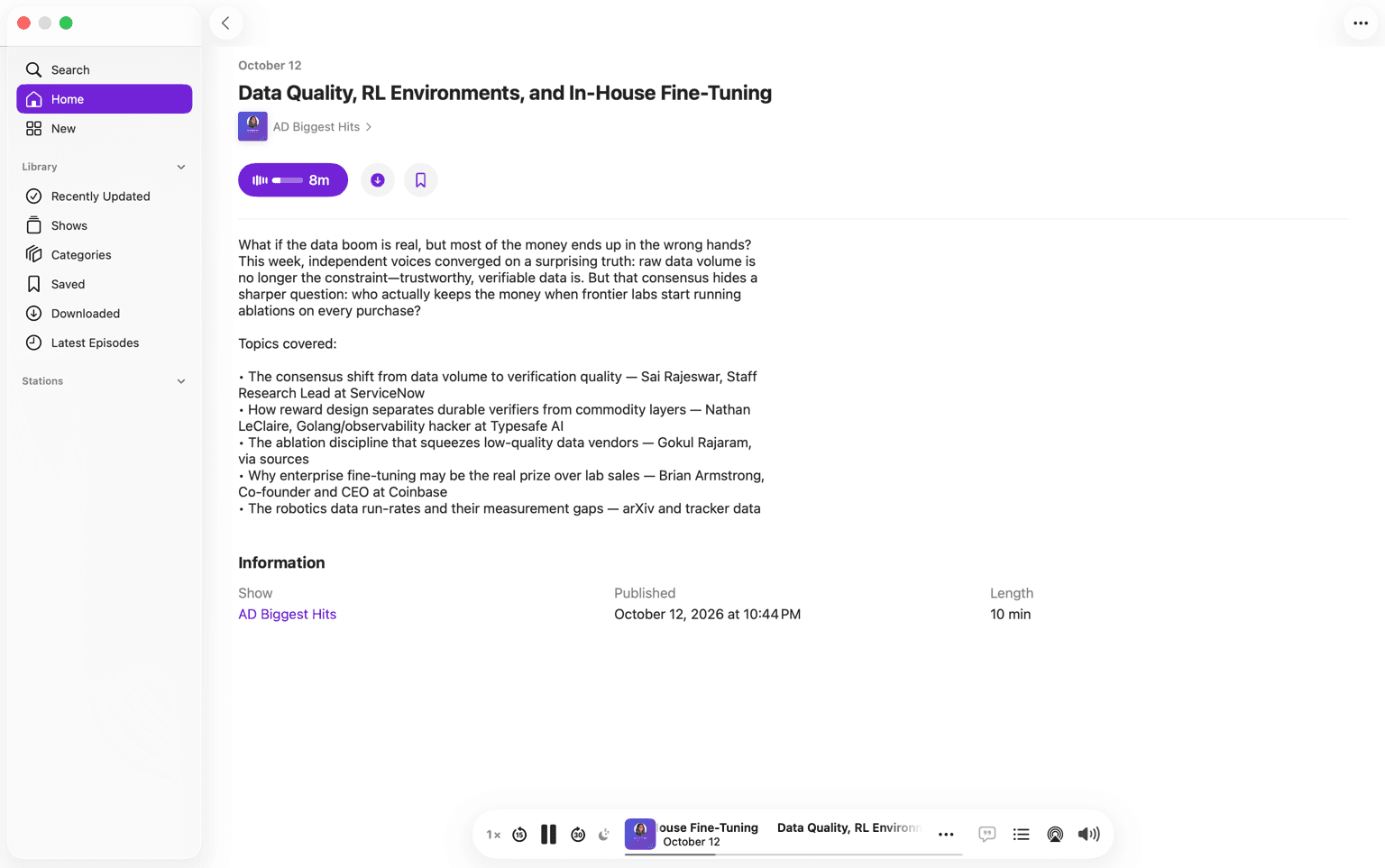
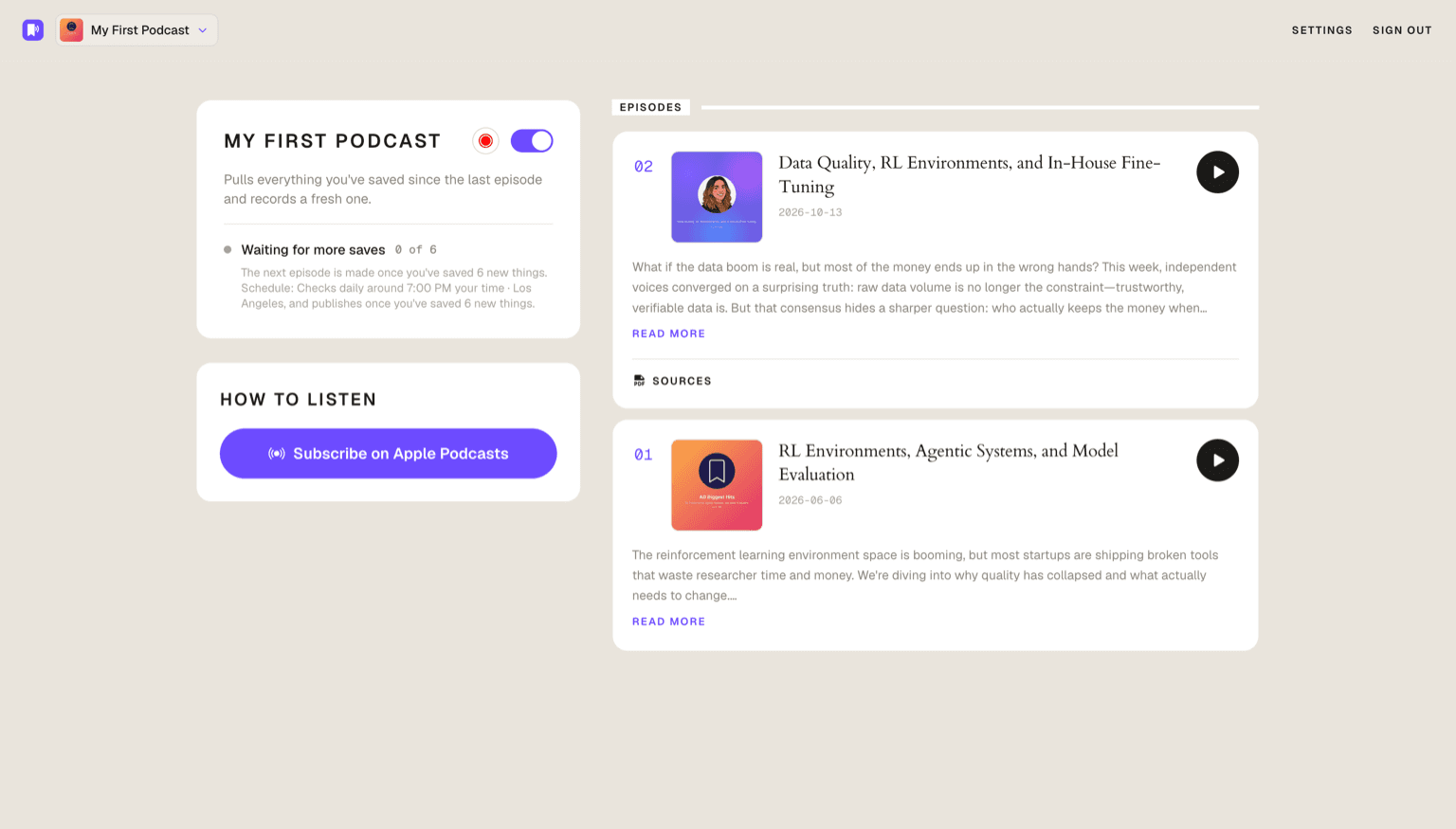
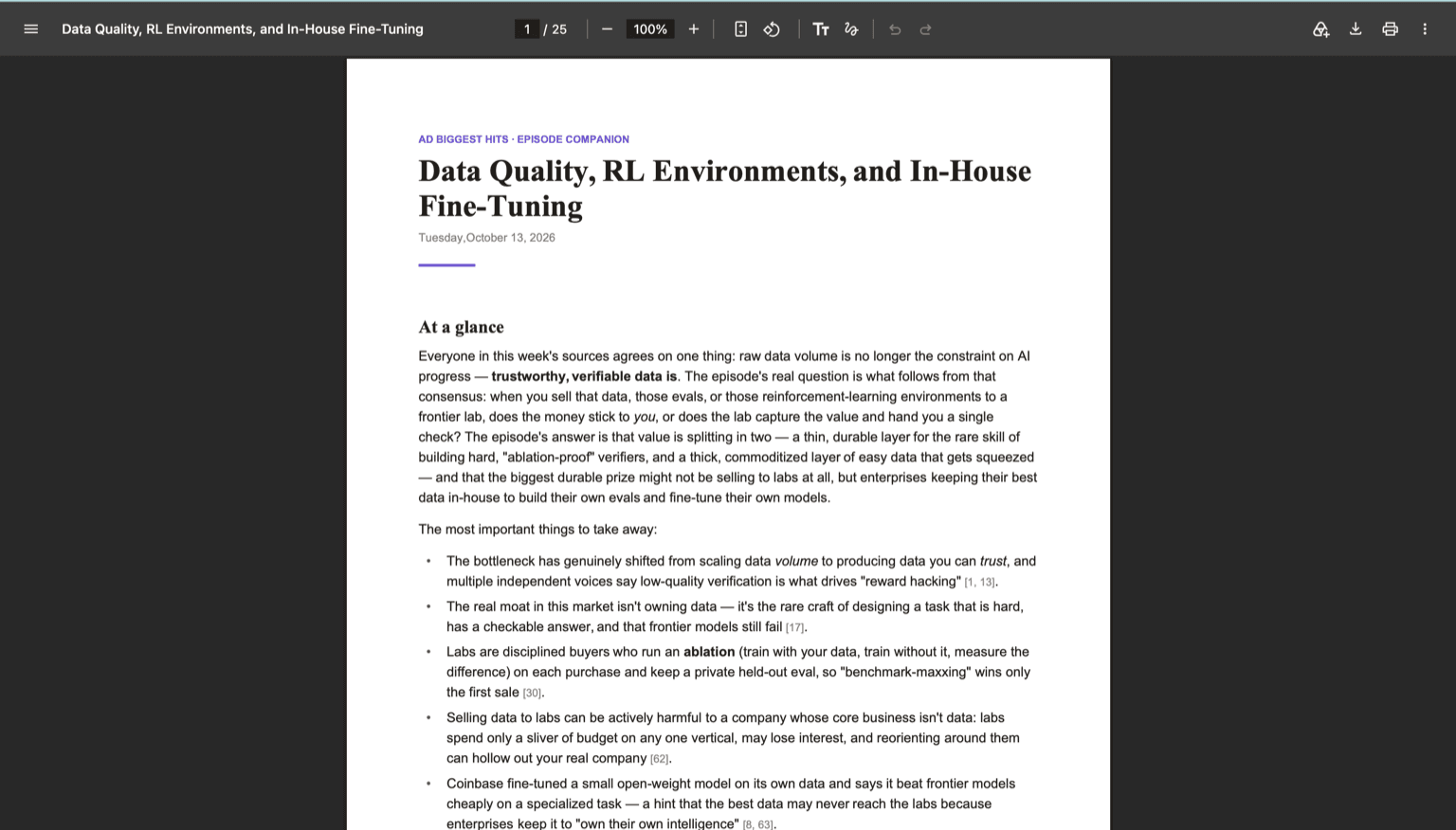
- It shows up in your podcast app. Subscribe once and each new episode lands in Apple Podcasts (or any podcast app) next to the other shows you follow, ready for your commute. Each one also comes with a written companion you can read later, with links to every source.
Under the hood
Every hour, the app checks whose episode is due and makes it in six steps. AI is used where it matters most: understanding what was saved, writing the episode, and giving it a voice.
Runs every hour for each show that's due
- 1Your saves
X, HackerNews, LinkedIn, Chrome reading list, or a topic you follow on arXiv
- 2Collect
Everything new since the last episode
- 3ReadGemini + Google Search
Opens the linked articles and looks up who wrote each post
- 4WriteClaude
A briefing, a plan for the episode, the script in the show's style, and the written companion
- 5RecordElevenLabs
One host or two, in natural-sounding voices
- 6Your podcast app
Lands in Apple Podcasts or any podcast app, with cover art and a companion PDF
Defining good, then measuring it
Getting an episode made was the easy part. Knowing whether it was any good was harder, because "that felt off" isn't something you can fix. So before changing any prompts, I wrote down what good looks like for each thing the app makes, then listened and read against it.
Anything I marked as weak had to come with evidence: the exact moment, the quote, and what the source actually said. "At 3:12 it said X, but the article said Y" turns a vague feeling into a specific fix, and points to the step that caused it.
- What the episode says. Good means it explores one real question that could go either way, gives numbers with something to compare them to, doesn't pass opinions off as facts, and draws a conclusion no single source states on its own. My quick test: if it could have come from asking a chatbot to summarize the links, it isn't good enough. Early episodes walked through the topics in order, and the co-host only cued up the next fact. Now each episode is planned first (the central question, the strongest counterargument, what the sources don't say), and the co-host plays a skeptic who asks things like "compared to what?"
- How it sounds. Good means a curious, smart friend explaining something, not a news announcer or an audiobook narrator. Measuring the first episodes showed they were slow (about 130 words a minute, where real conversation runs 150 to 170), full of stock phrases like "here's the kicker," and the two-host episodes sounded scripted. Scripts are now written for the ear: short sentences for the hard parts, numbers said the way people say them, no stock phrases, and voice settings tuned for each style.
- What you read afterwards. Good means you can use it to catch up on a part you missed, understand an idea you didn't follow, or come back weeks later without replaying the episode. So the companion isn't a summary in order. It has a two-minute "at a glance," a guide to each part of the episode with timestamps to listen again, plain-language notes on each key idea, the disagreements, a glossary and a short self-test, with every claim linked to its source.
Try it
Bookmarked is live. Connect one place you save things, and your first episode is made right away.