May 2026
Stories
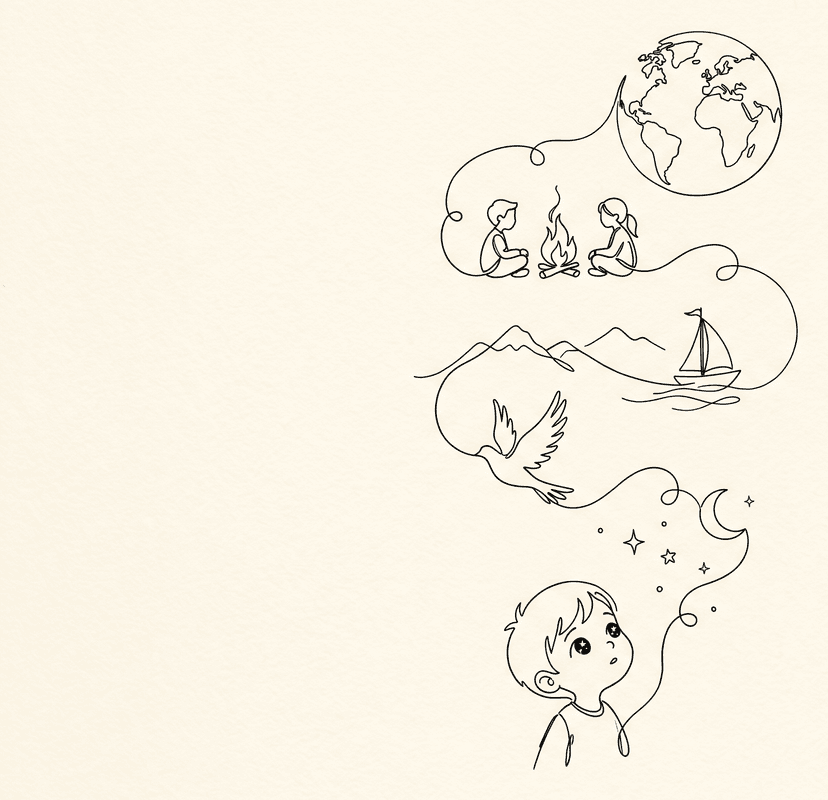
The night I was born, my grandmother looked at my eyes and said, “Iski aankhein toh Tim Tim kar rahi hain,” her eyes are sparkling. Tim Tim Tara: sparkling star. And just like that, I became Timtim.
My parents carried that story to me, and I’ve carried it ever since: a name, a moment, a quiet reminder of who I am and who I’m meant to be.
Cognitive scientist Mark Turner spends The Literary Mind arguing that we have story wrong. We treat it as something literary, a thing for novelists and poets, when it is actually how the everyday mind works. In his words, “Most of our experience, our knowledge, and our thinking is organized as stories.” The brain naturally organizes reality into actors, goals, conflict, and consequence rather than isolated facts, and that is how we remember, predict, teach, and make sense of who we are. It was our first compression algorithm for knowledge. Before writing, before mathematics, before formal logic, we had narrative, and through it we passed down survival wisdom, moral frameworks, and entire cultures across thousands of years without a single word written down. Memory itself isn’t a database. It’s reconstructive. Which means every time you recall something, your brain rebuilds it from fragments, shaped by who you are in that moment. So the story your brain tells about you keeps getting retold, and that retelling is your identity.
Turner takes it one step further. When we use one story to make sense of another, he calls it parable, and he argues it is how we understand almost anything new. We don’t meet a new situation from scratch. We project a story we already carry onto it and see what it tells us to do.
Some stories you’re born into, and others you choose to carry, and both shape how you show up.
The Bhagavad Gita is one I choose to carry. It’s a conversation within the Mahabharata (an Indian epic), set on the eve of a war between two sets of cousins. Arjuna, a warrior, stands on the battlefield of Kurukshetra, ready to fight, and then he freezes. Across from him are his cousins, his teachers, the people he loves, so he puts down his bow and tells Krishna, his charioteer and guide, that he cannot do this. What is the point of victory if it costs you everyone?
Krishna’s answer is the Gita. He doesn’t tell Arjuna to stop feeling; he tells him to stop letting feeling override duty. Your role in this world, your karma, is not negotiable based on how you feel today.
तस्मादुत्तिष्ठ कौन्तेय युद्धाय कृतनिश्चयः
Therefore rise, son of Kunti, resolved to fight.
Do what you’re here to do, and release your grip on the outcome, because you are not entitled to the fruits of your actions, only to the actions themselves.
That lesson lives in my episodic memory at index 754953, a story I return to every time the weight of discomfort makes me want to run.
I believe we understand the world through stories, and that we ultimately become who we are through the ones we choose to carry: the ones told to us before we could speak, the ones we find in ancient texts, and the ones we write ourselves, one decision at a time.
My work, and my life, is shaped by this belief. I live for a good story.